
One Blaze After Another
Fire and rain, choosing to have children, new movies, and the world’s most shocking sex scene.

It’s been raining in LA - which is no bad thing, as a small fire was started in a local park on Monday night. The blaze ignited in Ernest E. Debs Park – a favourite of mine. It rises up in a jungly hillside south of Highland Park, and is known as a birding hotspot – it’s where the local Audubon Centre is located. I once saw a merlin eating a smaller bird it had pinned onto a branch there, with a scrub jay hopping around beneath it, awaiting the scraps.
Despite the intense gentrification of Highland Park, with its vintage bowling alley, bars and formerly Masonic live venue, it still has a generations-deep gang culture. Around the time I started visiting Ernest E. Debs, a pair of local gangbangers killed two young women and attempted to conceal their bodies there. The fire last night was initially blamed on arson, with an arrest made, and I suspect the park still becomes a different place after dark.
—
You know you’re an Angeleno when you enjoy the rain. It produces the same, cozy feeling as snow might in Britain. And it always comes as a relief, after the long, scorching months of summer. Apparently, it’s also now an excuse for more sensitive souls to avoid the office – even, amusingly, some British expats.
The rain makes me think of Britain, and oddly enough stokes a craving for the Scottish Highlands. How I long to be up on some craggy peak, blasted by the rain and wind and unable to think about anything but how wild the place is, or the need to simply keep going.
—
Inspired in part by James Marriott’s excellent SubStack, Cultural Capital, I decided to make this post a round-up of things I’ve found interesting over the last few weeks.
Will Storr, whose hyper-honest writing is very much my bag, wrote unflinchingly and movingly about a child-free life. This is something I’ve often pondered since having kids. There’s a book of essays by child-free writers, including one by the vocally non-parental Geoff Dyer. I found that piece to protest rather too much, something I often observe in the intentionally childless. Of course, that’s a complaint also – and fairly – levelled at parents, equally eager to justify their choice.
For anyone with the notion of being a writer, the cliché is that the pram in the hallway is a killer of creativity. But as Martin Amis once said, the opposite is true. Having children opens up a whole new realm – or species – of love. As a friend once observed, no one really experiences a near-unconditional love until they have children. Perhaps controversially, this intelligent and liberal friend said this is especially true of men. Certainly, parenting provides exactly the sort of deep experience that can be mined for good writing. As a corollary to this, novels about parenting by childless writers can be hilariously off mark.
The examples of novels where this isn’t true might be signs of great talent – Philip Roth and American Pastoral spring to mind. We Need to Talk About Kevin, too – funnily enough, a very good novel about parenting, by a non-parent, often touted by the intentionally childless as evidence they made the right choice.
And anyway, the ‘pram in the hallway’ was coined by Cyril Connolly, who eventually had two children. He was the contemporary – and occasional whipping boy – of Evelyn Waugh, who had lots. The fact that Waugh was one of the greatest novelists who ever lived would seem to close the debate.
Of all the anti-parenting justifications, the only one that annoys me is the ludicrous notion that children are bad for the environment. (Think they’re bad – just wait until you hear about domestic cats!) I don’t think there’s nearly enough emphasis on the sort of nightmare this doom-culty dogma might engender.
--
Due to my interest in provocative art, I found it fascinating to read that trigger warnings create an active appeal for most people. This goes back to the childhood thrill of an X-rated movie or an explicit book – have you seen it? It rings true for me – anything that warns me off is an instant lure.
When Joker came out, I was taking part in a painfully LA, backyard bootcamp. I enjoyed this more than I could ever have expected, not least because of the trainer. He was a part-time actor, handyman and fitness instructor, and one of the nicest people I’ve met in LA. He would lead entire classes as a pitch perfect Mark Wahlberg (“OK, get down on the floor – gimme some push ups… Now eat a fuckin’ chicken!”) or Arnie. If a nonplussed, Airbnb couple emerged from the back house, and were forced to walk between us, he would spring up and say: ‘Good morning! Have you considered becoming a Scientologist?’
One morning, I arrived at boot camp having read a negative review of Joker1, which took the film to task on vaguely social justice terms. More importantly, it warned of sleepless nights due to its grimness. I related this excitedly to my sweaty companions.
‘You want to have sleepless nights?’ one of them asked, sceptically.
Not really, of course. But a movie hadn’t given me sleepless nights since Nightmare on Elm Street, and I did want to see something thrillingly dark and violent, in the way the icons of ’70s movie making were.
--
Which leads me to the NIN soundtrack for Tron. Add Violence, the title of their 2017 EP, still strikes me as excellent. The Tron soundtrack is the best new album I’ve listened to recently, because it satisfyingly merges the fathoms-deep moods of Reznor and Atticus Ross’ soundtracks, with NIN’s industrial-pop – and knack for a great tune.
--
I hope one day there’ll be a resurgence in cinema attendance, because it makes a great night out. Or perhaps it’s simply a mid-’40s sweet spot. You can drink, but not too much. You don’t have to do lots of talking, and you’ll hopefully engage with something interesting.
I went to see One Battle After Another on Sunday night. Paul Thomas Anderson’s latest – based very loosely on Thomas Pynchon’s Vineland (incidentally, my least favourite of his novels) – has been both widely acclaimed and controversial. The film’s scenes of freedom fighter/ terrorist attacks on immigrant detention centres must’ve been written years ago, so their topical relevance is unintentional. And the notion of a leftwing rebel group anyway comes from the Pynchon novel.
What has annoyed conservatives has delighted progressives2, who are perhaps overpraising the film. I thought it was good, but not brilliant. For me, the problem wasn’t politics but tone. Were we supposed to be amused, or afraid? Worried for the characters or laughing at how zany/ whacky/ loveable they were? Menaced by the shadowy right-wingers, or guffawing at how cartoonishly they were portrayed? In particular, I found Sean Penn’s performance to be too bluntly caricatured. I did enjoy the ‘car chase’ though.
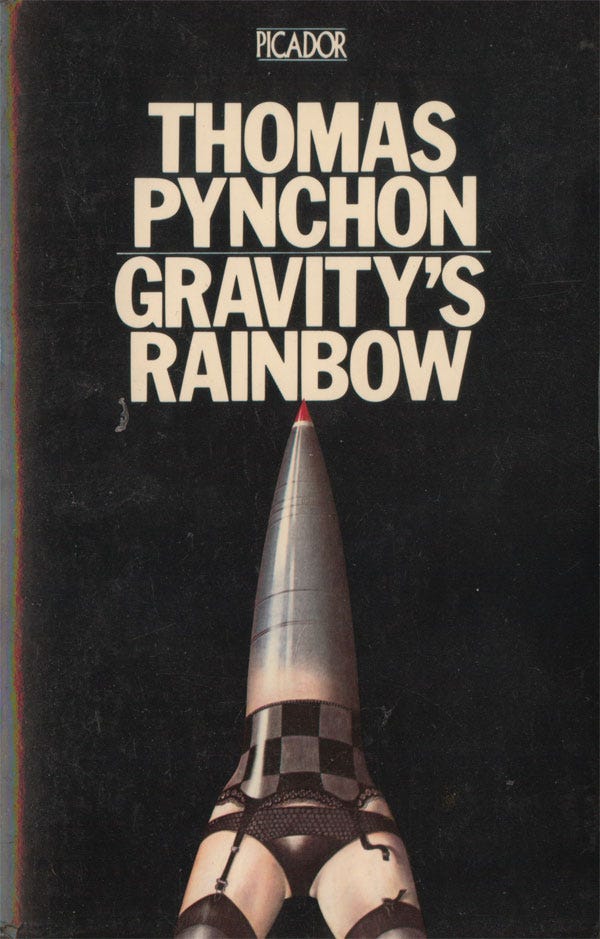
A multitude of tones is perfectly feasible in films – just look at the menace/ humour of Once Upon a Time in Hollywood, but I don’t think OBAA got it quite right. Like this precocious young lady, I just happened to be re-reading Gravity’s Rainbow when I went to see the film. One of the chief pleasures - among the wealth the novel offers - is how effortlessly Pynchon switches tones: A page or two can segue from visceral beauty through off-colour farce to hackle-raising paranoia and menace. Perhaps that’s something that can only be done in a novel?
But oh, the pleasure of sinking back into that comfortable cinema seat after a long day’s parenting, the anticipation of what may emerge on that vast silver screen, and the powerful, alcoholic tug of a pint-sized, Cadillac margarita. Middle-aged bliss.
--
Incidentally, Gravity’s Rainbow contains arguably the most incendiary, transgressive sex scene in literature – certainly one that couldn’t be published today, and would be enough to get anyone who tried it ‘cancelled.’ Perhaps the fact it’s buried in a giant, giddying masterwork gives it protection enough. The cancel culture types are too busy scrolling through social media, flitting around the internet like a school of idiotic fish – their minds gradually atrophying – to ever engage with Gravity’s Rainbow. They don’t know what they’re missing.
In the end, Joker’s deficiencies were nothing to do with its darkness. If anything, it was perhaps too enamoured with its own influences.
It’s tempting to write a whole post on the hell of reading Richard Brody versus the heaven of Anthony Lane.