
The Stabbings
Ninja Tune, Wiley & me: Part Six

NOTE:
I’ll be in London on July 3 to read from The Rejects at Book Slam, in Westbourne Park. There’s a great line up - including music from BERWYN - and it’s free to get in. More info here. It’s great to have friendly faces at these things, so if you’re free and in London I’d love to see you.
On one of the trips we made together, Wiley pulled up his shirt and showed me some of his fourteen stab wounds. Two sets of seven. Both sets had been inflicted by the same group of men, on two separate occasions. Little puncture scars, rough edged and paler against his skin.
Wiley has spoken openly about what happened: A drama over money owed to a friend of his had spiralled out of control. Wiley turned up to an east London rave to be set upon by dozens of other young men. He was stabbed in the torso, back, leg and ‘bum’, and hospitalised for several weeks.
Once he was out, he went to west London – outside his comfort zone – to buy some new trainers. By terrible coincidence, the ‘boy who stabbed’ him was in the shop, accompanied by friends.
‘I’m stupid, J,’ he told me. ‘Because I’m Wiley’ – as if scorning his own persona – ‘and I was like “I ain’t backing down.”’
A fight immediately broke out, and Wiley was chased out of the shop and down the street. He managed to tear out a For Sale sign outside a house and swing it at them, but they overpowered and stabbed him again.
This time, he ‘nearly died’. His lung had collapsed in the first stabbing, and he’d been told to be careful about smoking. Not that this had reduced his intake of weed.
Why does this stuff happen, I asked him?
‘Because we’re black men, J,’ he said.
Something along the lines of this experience made it onto Playtime is Over, in the form of the lyrics to Slippin’:
I was slippin’ in southwest London
No strap, no ’chete on my ones with the gash
I had to splurt from southwest London
Wrong place, wrong time no you can’t have a stripe
A strap is a gun, while ’chete and gash are both grimly obvious. Sadly, in reality the gang of young men in West London had got their stripe.
He didn’t feel at all sorry for himself for the stabbings. He considered them entirely his own fault. He was erratic, charming, funny and loveable.
‘You’re a full-time job,’ I told him during one of the trips.
‘I know,’ he said, widening his eyes and puffing out his cheeks to expel air – he often did this in contrition or stress. ‘That’s what my mum says.’
He told me of his upbringing. I wish I could tell the story in turn, though propriety and legality both preclude my doing so. Understanding where Wiley comes from is crucial to this story. Suffice to say that he casually reeled off images from his childhood that would qualify for the darkest of misery memoirs. To him it was just stuff that had happened, that he’d got through, that was less important than his life – and musical mission – in the present.
The episodes could darken. In grime, there was always a contest between different crews, played out by the MCs. These could easily spill over into street violence. As one of grime’s biggest stars, and one who hadn’t left ‘the ends’ as Dizzee had, Wiley made a tempting target. In 2006 he began ‘warring’ with the Movement, a crew consisting of MCs Ghetto (nowadays known as Ghetts, and still having some success) and Scorcher.
When I booked grime DJ Logan Sama and the Movement to appear at my club night, Wiley turned up out of the blue - and alone - to battle them live. He arrived before Scorcher and Ghetts, and when I asked him why MCs were always late, he said ‘because we feel special, J.’ That night, outside the lyrics, things seemed quite civilised. Usually, these MCs were friends of his – Scorcher even went on to appear on the album. But I would come to learn that these relationships could turn very quickly.
The lyrical battle became a real one when Wiley bumped into Ghetto on Roman Road in Bow. In Wiley’s telling, Ghetto pulled a knife and chased him. Wiley, carrying a bag with his laptop in it, realised he needed to shed this weight in order to escape. He tossed the bag into the doorway of Rhythm Division, the record store that had been pivotal in grime’s early success. Ghetto stopped and picked up the bag, and the laptop disappeared. On it were several demos that Wiley had recorded and didn’t have backed up.
I was only to hear about the subsequent drama a few days later. After threats and pleas had done no good, Wiley had turned to a dark figure for help. Someone on the fringes of his life was a serious organised criminal. In one of his runs of major label pop success, Wiley had purchased a Bentley. This man had told him to return it.
‘Nah,’ he’d said. ‘You can’t have that. I can’t have you in that.’
It wouldn’t do for Wiley to be seen to outshine him. He told me of some of the brutal ways in which the man made his living.
‘You never want to get into debt with him, J,’ he told me. But Wiley had – by borrowing a gun.
In Wiley’s version, once he had it, he kicked in Ghetto’s door. The rival MC’s mum was on the other side of it, and Wiley ran into the house and managed to retrieve the laptop. Wiley’s searing Nightbus – aimed at the Movement and widely considered one of grime’s high points – referred to the incident. ‘Don’t make me run at you waving my gun at you / crying to my mum and your mum ’cos I came and duppied you.’
Ghetto would later refer to the events in his Darkside Freestyle, claiming that an unnamed adversary had ‘come to my house and kicked in the glass / next day I made him pay for a new door / he ain’t a bad boy / I took man to the cashpoint.’
Despite the lyrical bravado, I had the sense that everyone involved (except, presumably, the gangster) had frightened themselves with this incident, and it quickly settled down.
Despite Dizzee clearly blaming Wiley for what had happened in Ayia Napa, I rarely heard a negative take on Wiley from anyone who knew him. In the mid 2000s, there was a magazine called RWD that was key to the British black music scene. I got to know a man who sold the ads for it. Like many publications in an era of failing sales, the line between advertising and editorial had begun to blur. Many upstart grime artists were effectively purchasing coverage as an effective route to success. A grime crew had done exactly this, but hadn’t paid their invoice. The RWD ad man had been chasing them.
One night, at the dubstep night FWD at Plastic People, he ran into them again. He pressed them to pay, and things turned sour. In the toilet, he bumped into Wiley. ‘Listen bro,’ Wiley apparently told him. ‘You better get out of here. Something’s gonna happen.’
The advice either came too late or the ad man failed to heed it. He was badly beaten up by the crew, who were subsequently shunned by anyone who mattered, and promptly dissolved.
‘He’s supposed to be this hard man,’ the ad man said to me of Wiley. ‘But he didn’t do anything.’
But what could he have done, exactly? And anyway, outside of a few lyrics and temper fits, Wiley didn’t play the hard man at all. He was slim, friendly, unaggressive, wary.
His bravado got him into trouble. There was a pirate radio appearance during which Wiley, who’d fallen out with his cousin and fellow MC, God’s Gift, relentlessly taunted him on air. The show was recorded, and listeners could hear the sound of God’s Gift arriving in the studio, the record stopping, the shouting and thudding and then the dead air.
Another knife wound on Wiley’s back, which he told me about the next morning.
‘They didn’t get my face, J’ he said, sounding unperturbed.
After the album was out, things gradually slowed in intensity. On Christmas Day 2007, I got a series of texts. Wiley was saying he wanted to listen more, that his dad had told him he should, that he was sorry he hadn’t always listened.
A few months after Playtime’s release, he’d quickly recouped his publishing advance and had a royalty cheque due of a little over £500. When I called to tell him, he insisted he wanted to give it to me.
‘I’m already getting paid,’ I told him.
‘Na-na-na, J,’ he said, ‘I told you I’d take care of you.’
We argued for fifteen minutes or so, until he made clear that he wouldn’t accept any other outcome.
I told Peter Quicke, the Ninja boss, of the predicament, and he told me I’d keep half and Ninja would take the other. Those, looking back, were leaner years for the label.
Eventually Wiley announced on Twitter that he was leaving Big Dada. Will Ashon cleverly released a statement along the lines of ‘Wiley is a one, isn’t he?’
The door was left open, and a pattern established. Wiley would make a major label pop album, fall out with everyone - sometimes before the project saw the light of day – then return to us to make a grime record. The split nature of his personality – grime MC/pop star, thoughtful/wild, happy/sad – played out on the stage of his very career.
Will made the point that if he’d been born in the US, where a real infrastructure and market existed for rap music, Wiley wouldn’t have had to make the distinction between the street and the stars.
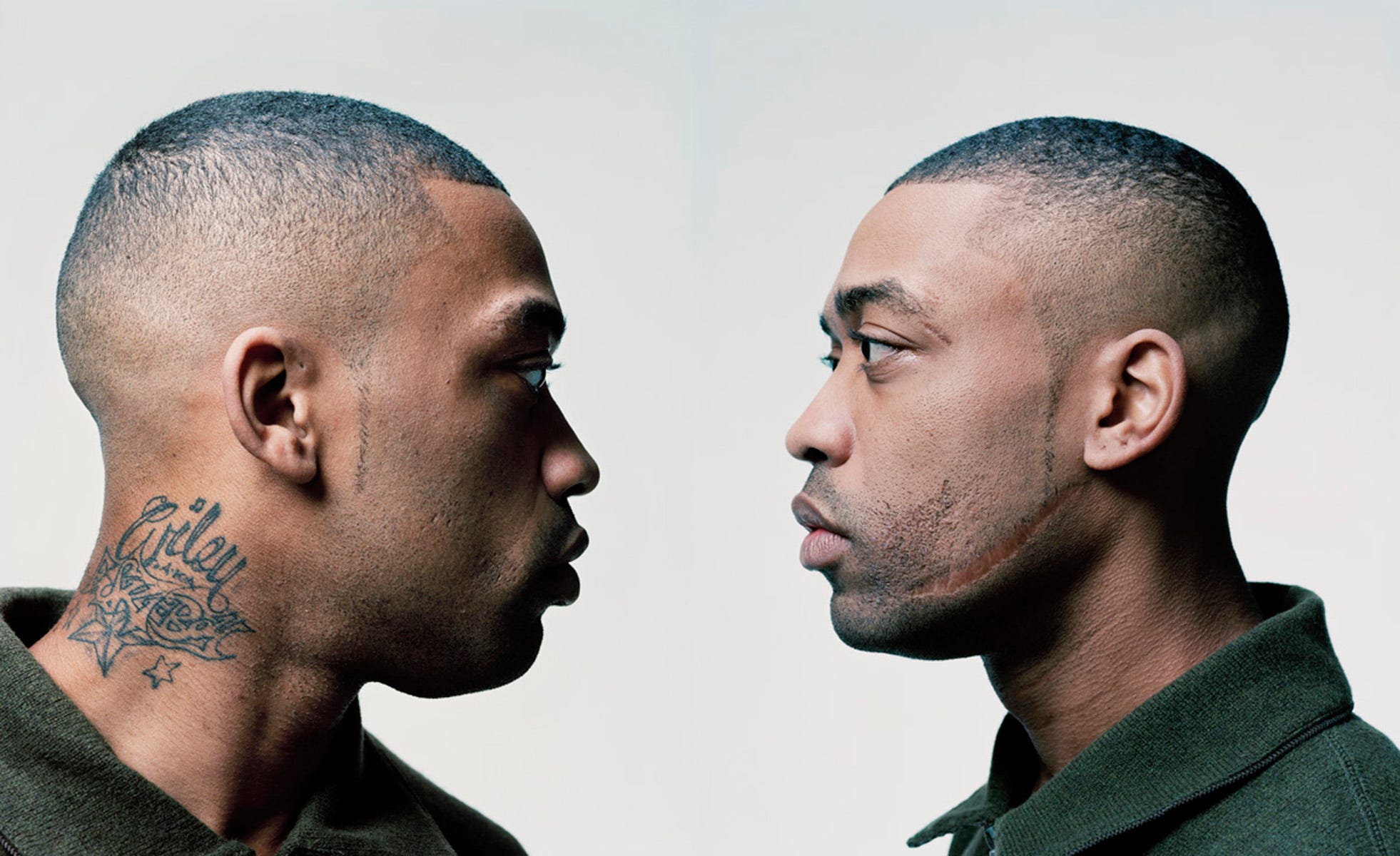
He came back to make more records. The A & R credits became single, and in my name, but the process never changed - we just got used to it. There were more episodes. His arrival in the office, a little older and more seasoned, a toddler daughter in tow. He’d had a pop hit in 2008 with Wearing My Rolex, but the major label deal had gone sour, and he wanted to make grime again. He had a huge new scar along his jawbone to his chin.
‘What happened with that scar?’ I asked him when we were alone.
An older man – his dad’s age – had wanted Wiley to get his son on the radio. When it had become clear that Wiley was unable to do this, the son having no talent, the man and his friends had ambushed Wiley on the street one night. They pinned him down and slashed his face with a Stanley knife, a deep, deliberate cut several inches long.
‘I’m so sorry, mate,’ I told him. I was barely able to process the rage and horror of all this.
‘It’s all right,’ he said. But it wasn’t. He was self-conscious about the scar in subsequent photoshoots. His face was the part of him he’d been pleased to preserve through these bouts of violence.
One night, sitting in an armchair at home, at almost midnight: a series of texts that were alarmingly self-lacerating. I did my best to reassure him.
‘I love you bro,’ he texted me eventually.
‘I love you too mate,’ I told him.
Thoroughly enjoying these posts, Jamie, although this one strikes a more sombre tone. I should have spoken to you for my book, lord knows Wiley gave me the runaround (to be expected).